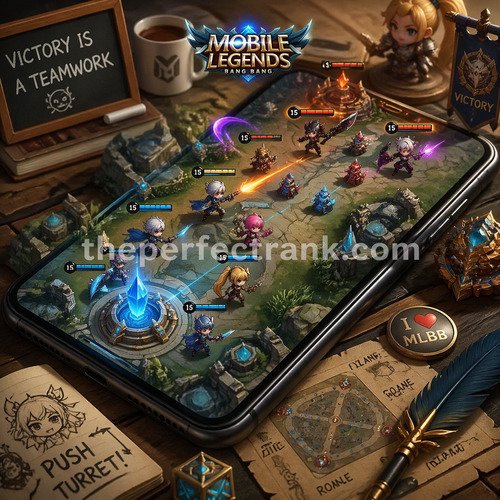
theperfectrank.com – Mobile Legends: Bang Bang is a game that combines mechanical execution, strategic planning, teamwork, and fast decision-making into a single competitive experience. A player may have excellent control over a favorite hero, but mechanical ability alone does not always determine how effectively that player contributes to a match. The battlefield constantly changes as minion waves move, heroes rotate between lanes, objectives become available, turrets lose protection, and teams gain or lose access to important areas. Because of this, learning Mobile Legends requires more than memorizing skills or copying an item build. Players need to understand why certain decisions are made and how one action can influence the next several minutes of a match.
For new players, the most useful starting point is learning the basic rhythm of a match. Early gameplay often revolves around collecting resources, establishing lane pressure, and reaching important level and equipment thresholds. As the game develops, players begin rotating, contesting objectives, protecting structures, and preparing for larger team fights. Later stages usually place greater importance on positioning and coordinated decisions because a single mistake can have a much larger effect. Understanding these stages allows players to stop treating every moment as an isolated encounter. Instead, they can see the match as a sequence of connected situations in which each advantage or mistake creates consequences.
Building a Strong Foundation for Mobile Legends Gameplay
Before trying to master complicated strategies, players should understand the basic purpose of the hero they are using. Mobile Legends contains many heroes with different abilities, ranges, mobility options, defensive tools, and damage patterns. Although every hero has individual characteristics, general roles can help players understand what kind of contribution their character is expected to make. Marksmen usually need resources and safe positioning so they can provide sustained damage later. Tanks often create space, absorb pressure, initiate engagements, or protect teammates. Mages may specialize in burst damage, crowd control, zoning, or area pressure. Assassins frequently depend on timing and positioning to reach vulnerable targets. Fighters can often operate between frontline durability and offensive pressure, while Supports may provide healing, protection, control, or other forms of utility.
Understanding the role does not mean following a rigid script. A player may need to behave differently depending on the opposing composition, the state of the lanes, and the location of teammates. However, having a basic responsibility prevents many common mistakes. A damage dealer should not automatically enter the center of every fight, just as a frontline hero should not always chase an enemy far away from the rest of the team. Players should constantly consider what their hero does particularly well and how those strengths can help the team. When a hero’s purpose becomes clear, decisions such as farming, rotating, defending, or fighting become easier to evaluate.
Another useful habit is learning the limitations of the chosen hero. Every strength usually comes with some weakness. A hero with powerful burst damage may struggle if abilities are missed or placed on the wrong target. A hero with strong mobility may still be vulnerable when important escape tools are unavailable. Recognizing these limitations helps players avoid forcing situations that are unfavorable. Instead of asking only, “Can my hero defeat this enemy?” players can ask, “Under what conditions does my hero perform best?” This shift in thinking is an important part of developing better gameplay.
Managing Lane Pressure and Resources
Lane management is one of the foundations of Mobile Legends because minion waves continuously influence where players can safely move. A player who clears waves efficiently can create time to rotate, assist teammates, or prepare for objectives. However, simply pushing as quickly as possible is not always the best option. The location of the wave matters, as does the position of enemy heroes. If an opponent is missing from the map, pushing too far without information can expose the player to a gank. On the other hand, allowing an enemy to freely control a lane can give them access to resources and structures.
Players should therefore think about what their current wave position allows them to do. Clearing a wave before rotating can prevent the lane from immediately losing pressure. In some situations, keeping the wave closer to a safe area can reduce the risk of being attacked. In other circumstances, pushing aggressively may be useful because it forces an opponent to remain in lane while the rest of the team works elsewhere. The correct decision depends on what the team is trying to accomplish.
Gold and experience are equally important. A player who repeatedly leaves a lane without collecting resources may fall behind even if they participate in many fights. Conversely, someone who focuses entirely on farming while ignoring important objectives may become strong individually without helping the team convert that strength into a meaningful advantage. Good resource management requires balance. Players should collect available resources while remaining aware of moments when their presence is needed elsewhere. Over time, understanding this balance becomes one of the major differences between simply participating in matches and playing with a deliberate strategy.
Improving Mechanics Through Focused Practice
Mechanical skill is developed through repetition, but effective practice requires more than playing the same hero over and over. Players should understand what they are trying to improve. This might involve skill-shot accuracy, movement during combat, basic attack positioning, ability combinations, or knowing when to use defensive skills. Practicing without identifying a weakness can make improvement slower because the player may continue repeating the same mistakes.
One useful approach is to focus on the interactions that happen most often during actual matches. Learn how the hero approaches an opponent, how abilities can be combined, and what happens when an enemy attempts to escape. Practice both offensive and defensive situations. A player who only practices attacking may struggle when suddenly forced to retreat. Similarly, understanding the damage potential of a hero is useful, but knowing when that damage is insufficient can prevent unnecessary engagements.
Cooldown management is another important mechanical habit. Players should not think of abilities only as tools for dealing damage. Some abilities provide escape options, crowd control, mobility, or protection. Using such an ability carelessly can leave the hero exposed. As players become more familiar with their hero, they can begin predicting how the availability of particular skills will affect future encounters. This turns mechanical knowledge into practical decision-making.
Developing Better Map Awareness and Macro Decisions
The minimap provides information that is essential for both safety and opportunity. Players who rarely check it often discover enemy movements only after an attack has already started. By developing the habit of checking the map frequently, players gain more time to react. The minimap can reveal where teammates are positioned, which opponents are visible, and which parts of the battlefield may currently be vulnerable.
A simple example occurs when an enemy disappears from a lane. That disappearance does not automatically mean a gank is coming, but it should influence how aggressively nearby players behave. If several opponents are missing simultaneously, the risk becomes greater. Conversely, if most enemies are clearly visible on the opposite side of the map, a player may have more freedom to push or collect resources. Map information is rarely complete, so players must work with probabilities rather than certainty.
The minimap also helps with offensive decisions. If teammates are grouped near one side of the map while several enemies are visible elsewhere, there may be an opportunity to pressure a structure or objective. If a teammate is being attacked and the player is close enough to help, the map provides early warning before the fight becomes visible on the main screen. Over time, these repeated observations become automatic. Players begin anticipating movements instead of merely reacting to them.
Rotating With a Clear Purpose
Rotation is not simply moving from one lane to another. It is a decision to exchange time and position for a specific potential benefit. Players may rotate to help secure an objective, support an ally, create pressure, defend a turret, or force an enemy to retreat. If there is no clear reason for the movement, the rotation may simply waste time and resources.
Before leaving a lane, players should consider the condition of the minion wave and the likely response from the opponent. A poorly timed rotation can allow an enemy to collect an entire wave or damage a turret. On the other hand, a well-timed rotation can create a temporary numbers advantage that turns a difficult encounter into a favorable one. The difference often comes down to timing rather than mechanical skill.
Rotations should also account for distance and information. Moving through an area where several enemies are missing can be dangerous. Taking a safer route may require slightly more time but can prevent an unnecessary death. Communication can make rotations even more effective because teammates can prepare for the arrival of another hero. When several players move together with a shared purpose, the resulting pressure can be much stronger than isolated movements across the map.
Understanding Objectives and Map Control
Objectives provide structure to the match because they give teams reasons to contest particular areas. Turrets, neutral objectives, jungle resources, and waves all influence the amount of space a team controls. Players should understand that map control is not simply about occupying a location. It is about making certain areas safer for allies and more difficult for opponents to access.
Before attempting a major objective, teams should consider whether enough players are nearby, whether important abilities are available, and where opponents were last seen. Starting an objective while the enemy team has an easy path to contest it can create unnecessary danger. Sometimes controlling the surrounding area first is more useful than immediately attacking the objective itself. Clearing nearby waves, checking enemy positions, and creating pressure can reduce the opponent’s ability to interfere.
Objective control also requires recognizing when an objective should be abandoned. If the enemy team arrives with superior numbers or important abilities while your team is already weakened, continuing to fight may turn a temporary setback into a larger loss. Strong macro play involves knowing when to contest, when to trade, and when to retreat. The goal is to maintain the team’s overall position rather than winning every individual confrontation.
Positioning Before and During Team Fights
Team fights become much easier to understand when players stop viewing them as chaotic exchanges and instead identify each hero’s responsibilities. A frontline hero may need to create space, while a damage dealer needs to find a safe angle from which to attack. A Support may need to protect an important teammate, and an Assassin may wait for an opening rather than entering at the beginning. These responsibilities influence where each hero should stand.
Positioning should change as the fight develops. An area that is safe at the beginning can become dangerous after an enemy uses a mobility skill or changes targets. Players should constantly monitor threats instead of remaining stationary. Damage dealers in particular need to balance offensive output with survival. Dealing damage is valuable only while the hero remains alive and capable of continuing the fight.
Timing is equally important. Entering immediately is not always the correct choice. Sometimes waiting for an enemy’s major crowd-control ability to be used creates a better opportunity. In other situations, delaying too long can cause an ally to be eliminated. Players should therefore learn to read the fight and identify moments when their presence will have the greatest impact.
Turning Team Fight Wins Into Real Progress
A successful team fight should usually create an opportunity beyond the fight itself. If several opponents are eliminated, the team may have enough time to push a turret, secure a neutral objective, collect resources, or establish deeper control of the map. Choosing the correct follow-up can determine whether the team gains a temporary advantage or a lasting one.
One common mistake is continuing to chase enemies after the main threat has already been removed. The remaining opponent may be running toward safety, and following them too far can separate the team. The time spent chasing could instead be used to take an objective. Players should therefore think about value rather than simply the number of eliminations they can obtain.
The same concept applies after losing a fight. If several teammates are eliminated, the surviving players should avoid creating another disadvantage through unnecessary aggression. Defending waves, protecting structures, and gathering safe resources may reduce the enemy’s ability to capitalize on its advantage. A disciplined response can prevent a single lost fight from becoming a decisive collapse.
Staying Consistent When the Match Changes
Every Mobile Legends match contains unexpected situations. A teammate may lose a lane, an enemy may become unusually strong, or a planned objective may become impossible to contest. Players who rely on a fixed strategy may struggle when the original plan stops working. Adaptation is therefore one of the most important long-term skills.
When ahead, players should consider how to protect their advantage rather than becoming careless. Aggressive movement can be useful, but unnecessary deaths can give opponents a chance to recover. When behind, players should focus on reducing risk while searching for opportunities. This may involve defending important lanes, avoiding isolated fights, or waiting for opponents to make positioning errors.
Consistency comes from applying sound principles under changing circumstances. Checking the minimap, understanding resource priorities, protecting important abilities, and evaluating fights before entering them remain useful whether the team is winning or losing. The details change, but the decision-making process remains familiar. This is what allows players to become more reliable across different matches rather than depending on a single successful strategy.
Conclusion Mobile Legends Strategy Guide: How to Improve Gameplay, Lane Control, and Team Coordination
Improving at Mobile Legends is a process that combines mechanical practice with strategic awareness. Players need to understand their hero, manage lanes and resources, develop reliable ability usage, read the minimap, rotate with purpose, control objectives, and position themselves correctly during team fights. None of these elements should be treated as completely separate skills because they continuously affect one another throughout a match.
For players who want to develop better gameplay habits, a useful approach is to focus on decision quality rather than simply chasing kills or statistics. Ask why a fight is happening, what resources are available, where missing opponents could be, and what the team can gain after a successful engagement. With repeated practice, these questions become increasingly natural. Mobile Legends becomes less about reacting to isolated events and more about understanding the relationship between lanes, objectives, positioning, resources, and timing. That broader perspective can make matches easier to read and provide a stronger foundation for continued improvement.
